

Introduction
Over the last few years, artificial intelligence has transformed the way businesses approach content marketing. What was once considered an emerging technology has now become an important part of daily marketing operations for agencies, brands, ecommerce businesses, and content teams around the world.
The demand for content continues to grow across every digital channel. Businesses need blog posts, landing pages, service pages, email campaigns, social media content, product descriptions, and educational resources to remain competitive online. At the same time, search engines have become more sophisticated, customer expectations have increased, and competition for visibility has intensified.
For many organizations, producing enough high-quality content to meet these demands can be challenging. This is where AI content marketing tools have started to play a significant role.
However, there is a common misconception that AI tools can simply replace writers, marketers, and SEO professionals. In reality, the most successful agencies use AI differently. Rather than replacing human expertise, they use AI to support research, streamline repetitive tasks, improve efficiency, and accelerate content workflows.
The result is not less human involvement but smarter human involvement.
At The Fabcode, and across the broader digital marketing industry, AI is increasingly being viewed as a productivity partner. It helps marketers spend less time on repetitive tasks and more time focusing on strategy, creativity, audience needs, and business growth.
In this guide, we’ll explore how modern agencies are using AI content marketing tools in 2026, the benefits they provide, the challenges they create, and how businesses can implement AI while maintaining content quality, trust, and search engine visibility.
The Evolution of AI Content Marketing
To understand the value of AI content tools today, it’s important to understand how quickly the technology has evolved.
Just a decade ago, most marketing software focused on simple automation. Businesses could automate emails, schedule social media posts, and generate basic reports, but content creation remained almost entirely manual.
Writers conducted research, created outlines, drafted articles, edited content, and optimized pages for SEO without much assistance beyond spelling and grammar tools.
The first generation of AI writing software offered limited capabilities. These tools could rewrite sentences, suggest grammar corrections, or generate short pieces of content, but they struggled with context, accuracy, and natural language.
The introduction of large language models dramatically changed the landscape.
Instead of generating isolated sentences, AI systems became capable of understanding context, analyzing information, and producing long-form content. This opened new opportunities for marketers.
Today, AI tools can assist with:
- Content ideation
- Topic clustering
- Keyword research
- Content briefs
- Article outlines
- First drafts
- Meta descriptions
- Social media content
- Email marketing copy
- Content repurposing
- Performance analysis
This evolution has fundamentally changed how agencies operate.
Rather than starting every project from a blank page, marketers can begin with research insights, draft structures, and content recommendations generated by AI systems.
This doesn’t eliminate the need for expertise, but it significantly reduces the time required to complete many content-related tasks.
Why Agencies Are Embracing AI Content Marketing Tools
Most digital marketing agencies manage multiple clients simultaneously.
A typical agency may be responsible for:
- SEO campaigns
- Website content
- Blog publishing
- Ecommerce optimization
- Social media marketing
- Email campaigns
- Content strategy
Managing all these responsibilities can create significant workload challenges.
AI tools help agencies improve efficiency without necessarily increasing team size.
Faster Research
Research is one of the most time-consuming aspects of content creation.
Before writing an article, marketers often need to:
- Understand the topic
- Review competitor content
- Analyze search intent
- Identify keyword opportunities
- Collect supporting information
AI tools can accelerate this process by organizing information and helping marketers identify key themes more quickly.
Instead of spending hours gathering preliminary information, teams can focus on analyzing insights and developing stronger content strategies.
Improved Content Planning
Content planning often requires significant brainstorming and strategic thinking.
Agencies must determine:
- Which topics to cover
- Which keywords to target
- How content supports business goals
- Which formats will resonate with audiences
AI can assist by generating topic ideas, identifying content gaps, and helping marketers develop content calendars.
This improves efficiency while still allowing human marketers to make strategic decisions.
Enhanced Productivity
One of the biggest benefits of AI is productivity.
Creating a high-quality article may traditionally require:
- Research
- Outline creation
- Draft writing
- Editing
- SEO optimization
AI can support each stage of this process.
The result is not necessarily faster publishing at the expense of quality. Instead, agencies can allocate more resources toward improving quality because less time is spent on repetitive tasks.
Understanding EEAT in the Age of AI
One of the most important considerations for businesses using AI is maintaining content quality.
Google’s guidance increasingly emphasizes the importance of:
- Experience
- Expertise
- Authoritativeness
- Trustworthiness
Collectively known as EEAT.
Many businesses mistakenly assume that AI-generated content automatically violates Google’s guidelines.
This is not accurate.
Google focuses primarily on content quality rather than the method used to create content.
If content is helpful, accurate, trustworthy, and provides value to users, it can perform well regardless of whether AI was involved in the creation process.
However, problems arise when businesses publish AI-generated content without oversight.
For example:
- Inaccurate information
- Outdated facts
- Generic advice
- Lack of expertise
- Weak user value
These issues can damage trust and reduce content effectiveness.
Successful agencies understand that AI should support expertise, not replace it.
The strongest content combines:
- Human experience
- Industry knowledge
- Strategic insights
- Original research
- AI-assisted efficiency
This combination helps create content that aligns with EEAT principles while benefiting from modern technology.
Why Human Expertise Still Matters
Despite rapid advancements in AI, human expertise remains one of the most important factors in successful content marketing.
AI can generate information.
Humans provide judgment.
AI can create drafts.
Humans create authority.
AI can identify patterns.
Humans understand customers.
This distinction becomes especially important for businesses operating in competitive industries.
Readers increasingly expect content that demonstrates real-world understanding rather than simply repeating information already available elsewhere online.
For agencies, this means sharing:
- Client experiences
- Industry observations
- Strategic insights
- Practical recommendations
- Lessons learned
These elements help differentiate content from generic AI-generated material and improve overall value for readers.
The agencies that will thrive in the AI era are not those that automate everything.
They are the agencies that combine technology with expertise to create content that is genuinely useful, trustworthy, and relevant.
Building an AI-Powered Content Workflow That Actually Works
Many businesses adopt AI content tools expecting instant results. They purchase subscriptions, generate articles, publish content, and wait for rankings or leads to appear.
Unfortunately, this approach rarely works.
The agencies seeing the best results from AI are not simply using AI to generate content faster. Instead, they are integrating AI into a structured content workflow that combines automation with strategy, quality control, and human expertise.
In other words, AI is most effective when it becomes part of a process rather than a shortcut.
Let’s look at how leading agencies build scalable AI-powered content systems.
Step 1: Research Before Content Creation
One of the biggest mistakes businesses make is starting content creation before understanding what their audience actually wants.
Many companies focus on writing first and researching later.
Successful agencies do the opposite.
Before creating any content, they answer questions such as:
- What problems is the audience trying to solve?
- What information are people searching for?
- Which keywords have commercial value?
- What content already ranks?
- What gaps exist in current search results?
AI tools can significantly accelerate this research process.
Instead of manually reviewing dozens of search results, marketers can use AI to summarize themes, identify common questions, and organize large amounts of information into actionable insights.
However, AI should never replace actual research.
The purpose of AI is to help marketers process information more efficiently, not eliminate the need for analysis.
A strong content strategy always begins with understanding user intent.
Understanding Search Intent
Search intent is one of the most important ranking factors in modern SEO.
Every search query represents a specific goal.
For example:
Someone searching:
“How to use AI content marketing tools”
is looking for education.
Someone searching:
“Best AI content marketing tools for agencies”
is evaluating options.
Someone searching:
“AI content marketing agency”
may be ready to hire a service provider.
Although these keywords appear similar, the intent behind them is very different.
Successful agencies use AI to identify patterns in search behavior and categorize keywords according to user goals.
This allows them to create content that matches what searchers actually want.
Google rewards content that satisfies user intent.
The better your content aligns with search intent, the stronger its chances of ranking.
Step 2: Creating Content Clusters
Another strategy used by high-performing agencies is topic clustering.
Instead of publishing isolated blog posts, they create groups of related content around a central topic.
For example:
Main Topic:
AI Content Marketing
Supporting Articles:
- AI Content Marketing Tools
- AI Content Writing Best Practices
- AI Content Creation for Ecommerce
- AI and SEO Content Strategies
- AI Content Automation Workflows
- AI Content Quality Control
This approach creates topical authority.
Rather than showing expertise on a single keyword, the website demonstrates expertise across an entire subject area.
AI tools can assist by identifying related subtopics, frequently asked questions, and content opportunities that support a larger content ecosystem.
For agencies like The Fabcode, topic clusters can help strengthen authority around digital marketing, SEO, ecommerce, Shopify development, and AI-driven marketing solutions.
Step 3: AI-Assisted Content Brief Creation
Before writing begins, leading agencies create detailed content briefs.
A content brief acts as a roadmap.
It defines:
- Target keyword
- Secondary keywords
- Search intent
- Audience profile
- Key talking points
- Competitor insights
- Internal linking opportunities
- Call-to-action strategy
Many AI platforms can generate content briefs quickly.
However, agencies should review and refine these briefs before content creation starts.
The most effective briefs include business-specific insights that generic AI tools cannot provide on their own.
For example:
A generic AI brief might recommend discussing AI content tools.
A human strategist might recommend discussing how AI tools support Shopify SEO campaigns because that aligns with the agency’s target audience.
This strategic layer is what separates high-performing content from generic content.
Step 4: Draft Creation Using AI
Once research and planning are complete, AI can assist with drafting.
This is where many businesses experience the greatest productivity gains.
Instead of spending hours creating a first draft from scratch, marketers can generate:
- Article outlines
- Introductory sections
- Supporting explanations
- FAQ ideas
- Meta descriptions
The key word here is assist.
Successful agencies rarely publish AI-generated drafts without substantial editing.
The first draft should be viewed as a starting point rather than a finished product.
Human editors should:
- Verify facts
- Improve readability
- Add expertise
- Include examples
- Strengthen brand voice
- Remove repetitive content
The goal is not to hide AI usage.
The goal is to improve content quality.
Readers care about value, not whether AI helped create a draft.
Step 5: Adding Real Experience
This is where EEAT becomes especially important.
Google increasingly values content that demonstrates genuine experience.
Many AI-generated articles fail because they simply summarize information already available online.
They lack:
- First-hand insights
- Industry observations
- Original examples
- Practical recommendations
For agencies, this presents a major opportunity.
Every campaign generates valuable experience.
Examples include:
- SEO challenges
- Ecommerce growth strategies
- Technical issues
- Content performance insights
- Marketing experiments
When incorporated into content, these experiences create differentiation.
Instead of writing:
“AI can improve productivity.”
An agency can write:
“After implementing AI-assisted content workflows, our team reduced content planning time while maintaining editorial quality standards.”
This type of insight is far more valuable because it reflects real-world application.
AI and Keyword Research
Keyword research remains one of the most important components of SEO.
AI has improved the efficiency of this process significantly.
Modern tools can help marketers:
- Discover keyword opportunities
- Identify search trends
- Analyze competitor topics
- Generate content ideas
- Group related keywords
However, keyword selection still requires strategic judgment.
Not every keyword is worth targeting.
Some keywords may have:
- Low commercial value
- Extremely high competition
- Weak conversion potential
Agencies must evaluate opportunities based on business objectives rather than search volume alone.
For example:
A keyword with 500 monthly searches that generates leads may be more valuable than a keyword with 10,000 searches that attracts unqualified visitors.
AI can support analysis.
Humans make decisions.
Content Optimization in the AI Era
Creating content is only part of the process.
Optimization remains critical.
Modern content optimization focuses on:
- Search intent
- User experience
- Readability
- Content depth
- Internal linking
- Topical authority
AI tools can help identify optimization opportunities.
For example:
They may recommend:
- Additional subtopics
- Missing questions
- Improved content structure
- Better semantic coverage
However, optimization should never become formulaic.
The goal is not to satisfy an algorithm.
The goal is to create the best possible resource for users.
When content genuinely helps people solve problems, rankings often follow naturally.
Why Publishing More Content Isn’t Always Better
One of the biggest misconceptions about AI is that more content automatically means better SEO performance.
This isn’t true.
Publishing ten low-quality articles rarely outperforms publishing one exceptional resource.
Quality remains more important than quantity.
Many businesses use AI to scale content production without improving content quality.
As a result, they publish hundreds of articles that generate little traffic or engagement.
Successful agencies take a different approach.
They use AI to:
- Improve efficiency
- Expand research
- Accelerate workflows
But they continue investing heavily in quality.
The future belongs to organizations that combine scale with expertise.
Not scale alone.
Creating Sustainable Content Systems
The most effective content strategies are sustainable.
Rather than chasing short-term traffic spikes, agencies focus on building systems that consistently produce value.
AI can support these systems by reducing manual workload and increasing efficiency.
However, sustainable success still depends on:
- Strong strategy
- Consistent quality
- Audience understanding
- Industry expertise
- Continuous improvement
AI is simply a tool.
The businesses that succeed will be those that use it strategically rather than blindly.
By combining AI capabilities with human expertise, agencies can create content that performs well in search engines, builds trust with audiences, and supports long-term business growth.
Choosing the Right AI Content Marketing Tool in 2026
One of the biggest questions businesses ask is:
“Which AI content tool should we use?”
The answer is rarely simple because different tools are designed for different workflows.
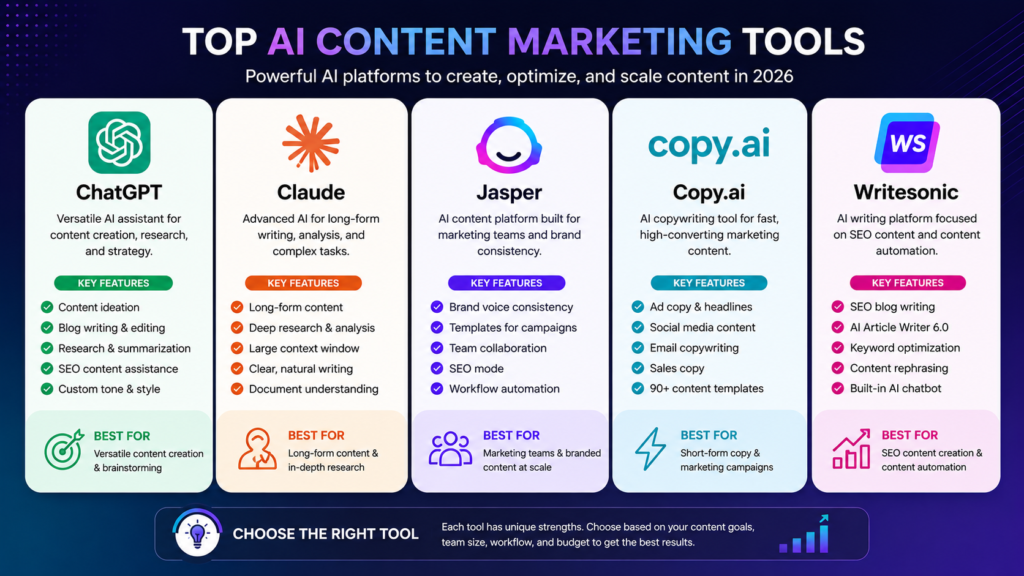
Some platforms are excellent for long-form writing. Others focus on SEO optimization, brand consistency, automation, or social media content.
For agencies, the best choice often depends on:
– Team size – Client needs – Content volume – SEO priorities – Workflow complexity – Budget
Let’s look at how the most popular AI content tools fit into modern agency workflows.
—
# ChatGPT: Best for Flexible Content Creation
ChatGPT remains one of the most widely used AI tools because of its versatility.
Agencies use it for:
– Brainstorming – Content outlines – Blog drafting – Email copy – Ad copy – SEO research – Content strategy – Social media ideas
Its biggest strength is flexibility.
Unlike tools built around rigid templates, ChatGPT can adapt to different content formats and marketing tasks.
For example, an agency can use it to:
– Generate a blog outline – Rewrite product descriptions – Create FAQ sections – Develop content calendars – Draft client communication
However, flexibility also means it requires strong prompting.
Teams that invest time in creating structured prompts often achieve much better results than those using generic instructions.
Another important point is that ChatGPT should not be treated as an autonomous content writer.
The best results come from:
– Clear prompts – Human editing – Fact-checking – Brand voice refinement
Agencies using ChatGPT effectively often build internal prompt libraries for different content types.
This improves consistency and efficiency across the team.
—
# Claude: Strong for Long-Form and Contextual Writing
Claude is particularly popular for long-form content and research-heavy writing.
Its strengths include:
– Handling large amounts of context – Maintaining coherence across long documents – Producing more natural-sounding prose – Supporting analytical writing
Agencies often use Claude for:
– Whitepapers – Detailed blog posts – Case studies – Research summaries – Strategy documents
One advantage is its ability to process extensive information without losing context as quickly as some other tools.
This can be useful when creating in-depth SEO content or industry reports.
However, Claude is not necessarily the best choice for every workflow.
For short-form marketing copy or rapid content production, some agencies prefer faster, template-driven platforms.
The key is matching the tool to the task.
—
# Jasper: Designed for Marketing Teams
Jasper is built specifically with marketing teams in mind.
Its features focus on:
– Brand voice consistency – Collaboration – Marketing workflows – Campaign content – Team management
This makes it attractive for agencies managing multiple clients and contributors.
One of Jasper’s biggest strengths is maintaining consistent messaging across content.
For agencies, this can help ensure that different writers and team members produce content aligned with a client’s brand voice.
Jasper also offers workflow features that support:
– Campaign planning – Content approvals – Team collaboration
However, these enterprise-oriented features often come with higher pricing compared to more general-purpose AI tools.
Agencies should evaluate whether the collaboration and brand management features justify the investment.
—
# Copy.ai: Useful for Workflow Automation
Copy.ai is often used for marketing automation and shorter-form content.
Common use cases include:
– Social media posts – Email campaigns – Product descriptions – Advertising copy – Sales messaging
Its template-driven approach can speed up repetitive marketing tasks.
For agencies handling high volumes of short-form content, this can improve efficiency significantly.
However, Copy.ai is generally less suited for highly detailed long-form content or deep analytical articles.
Many agencies use it as a supplementary tool rather than their primary content platform.
—
# Writesonic: Focused on SEO Content Production
Writesonic is frequently chosen for SEO-oriented content workflows.
Its strengths include:
– Blog generation – SEO optimization – Content structuring – Search-focused writing
For agencies producing large volumes of SEO content, Writesonic can help accelerate workflows and maintain consistency.
However, like many AI writing tools, the output still requires human review.
SEO content must do more than include keywords.
It needs to:
– Match search intent – Provide real value – Demonstrate expertise – Build trust – Engage readers
AI can support SEO content production, but it cannot replace strategic SEO thinking.
—
# Which Tool Is Best for Agencies?
There is no universal winner.
The best tool depends on the agency’s workflow and priorities.
Quick Comparison
| Tool | Best For | Main Strength |
|---|---|---|
| ChatGPT | Versatile content creation | Flexibility |
| Claude | Long-form content | Context handling |
| Jasper | Marketing teams | Brand consistency |
| Copy.ai | Short-form automation | Templates |
| Writesonic | SEO content | Search-focused workflows |
Many agencies actually combine multiple tools.
For example:
-ChatGPT for ideation and drafting – Claude for long-form refinement – Writesonic for SEO optimization – Copy.ai for social content – Jasper for brand consistency
The goal is not to find a single perfect platform.
The goal is to build an efficient content ecosystem.
—
# Cost vs. Return on Investment
Another important consideration is ROI.
AI tools are relatively affordable compared to hiring additional full-time staff.
However, businesses should evaluate value based on outcomes rather than subscription price alone.
A tool that costs more but saves significant time or improves content quality may provide a better return than a cheaper tool with limited effectiveness.
Agencies should consider:
– Time saved – Content quality improvements – Workflow efficiency – Team productivity – Client results – Revenue impact
The cheapest option is not always the most cost-effective.
—
# Avoiding Over-Reliance on AI
One of the biggest risks in 2026 is over-reliance on AI-generated content.
Some businesses publish large volumes of minimally edited AI content expecting fast SEO results.
This approach often leads to:
– Generic content – Weak engagement – Poor differentiation – Trust issues – Limited long-term performance
Google increasingly rewards content that demonstrates originality, expertise, and usefulness.
Agencies should use AI to enhance human capabilities, not eliminate them.
The strongest content still requires:
– Strategy – Editing – Fact-checking – Audience understanding – Brand storytelling – Industry expertise
AI can accelerate execution.
Humans create authority and trust.
—
# The Most Effective Approach for Agencies
For most agencies, the most effective approach is a hybrid model:
Hybrid AI + Human Workflow
- Use AI for research and ideation.
- Use AI to accelerate first drafts.
- Use AI to support SEO optimization.
- Use humans for strategy, editing, expertise, and final approval.
This model balances efficiency with quality.
It also aligns more closely with EEAT principles because human expertise remains central to the content creation process.
As AI technology continues to evolve, agencies that build strong hybrid workflows will likely gain the greatest competitive advantage.
AI GEO Optimization: The Future of Search Visibility
Over the last decade, SEO has been one of the most effective digital marketing channels for generating organic traffic. However, search behavior is evolving rapidly.
Today, users don’t just search on traditional search engines. They also ask questions directly to AI-powered platforms, conversational search engines, virtual assistants, and generative search experiences.
This shift has introduced a new concept often referred to as GEO (Generative Engine Optimization).
While traditional SEO focuses on ranking web pages in search results, GEO focuses on helping content become visible and reference-worthy within AI-generated answers.
For agencies and businesses, this means content strategies must evolve.
The goal is no longer simply ranking for keywords.
The goal is becoming a trusted source of information.
What Is GEO (Generative Engine Optimization)?
Generative Engine Optimization refers to optimizing content so AI-powered search systems can easily understand, trust, and reference it.
AI systems evaluate content differently than traditional search engines.
Instead of focusing exclusively on keywords, they often prioritize:
- Clarity
- Authority
- Accuracy
- Context
- Structure
- Credibility
This creates an opportunity for businesses that consistently publish high-quality content.
The stronger your expertise signals, the more likely your content is to be referenced within AI-generated responses.
How AI Search Is Changing Content Strategy
Many marketers still create content primarily around keyword density and rankings.
However, AI-powered search experiences are shifting the focus toward information quality.
Successful content now needs to answer questions comprehensively.
For example, instead of writing:
“What Are AI Content Tools?”
Businesses should answer:
- What they are
- Why they matter
- Who uses them
- Benefits
- Limitations
- Implementation strategies
- Best practices
- Future implications
Comprehensive coverage helps AI systems understand the topic more effectively.
This increases the likelihood of being surfaced in AI-driven search experiences.
Building Topical Authority
One of the most important concepts in both SEO and GEO is topical authority.
Topical authority means demonstrating expertise across an entire subject area rather than focusing on isolated keywords.
For example:
A website publishing one article about AI content tools may struggle to establish authority.
A website publishing:
- AI content tools
- AI SEO strategies
- AI content workflows
- AI marketing automation
- AI ecommerce applications
- AI content quality control
creates a much stronger authority signal.
Search engines increasingly evaluate expertise at the topic level rather than the page level.
For agencies like The Fabcode, this creates an opportunity to build authority around:
- Digital marketing
- Ecommerce
- Shopify development
- SEO
- AI marketing solutions
Over time, topical authority strengthens the entire website.
The Role of Internal Linking
Internal linking remains one of the most underutilized SEO strategies.
Every new article should support the broader content ecosystem.
For example:
This article could naturally link to:
- SEO services
- Shopify development services
- Ecommerce marketing guides
- Content marketing resources
- Technical SEO articles
Effective internal linking helps:
- Users discover additional resources
- Search engines understand relationships between topics
- Authority flow throughout the website
When combined with topic clusters, internal linking can significantly strengthen organic visibility.
Common AI Content Mistakes Businesses Should Avoid
While AI offers many benefits, there are also risks.
The most common mistake is prioritizing volume over value.
Many businesses publish dozens or hundreds of AI-generated articles without proper editing or quality control.
This often results in:
- Repetitive content
- Generic advice
- Weak differentiation
- Low engagement
Publishing more content is not the same as creating better content.
Quality remains the primary success factor.
Mistake #1: Publishing Without Fact-Checking
AI systems can occasionally generate inaccurate information.
For businesses, publishing incorrect information can damage trust and credibility.
Every article should undergo:
- Fact verification
- Editorial review
- Quality assurance
Trust is difficult to earn and easy to lose.
Mistake #2: Ignoring Brand Voice
Many AI-generated articles sound similar.
Without human editing, content often becomes generic.
Successful agencies ensure every piece of content reflects:
- Brand personality
- Industry expertise
- Audience expectations
This helps create differentiation in competitive markets.
Mistake #3: Creating Content Only for Search Engines
Some businesses become overly focused on rankings.
As a result, content becomes optimized for algorithms rather than users.
Modern SEO rewards content that genuinely helps people.
The best approach is simple:
Create content for humans first.
Optimize it for search engines second.
Mistake #4: Treating AI as a Replacement for Expertise
AI is a powerful assistant.
It is not a substitute for:
- Experience
- Strategic thinking
- Industry knowledge
- Customer understanding
Businesses that rely exclusively on AI often struggle to establish authority.
Those that combine AI with expertise achieve better results.
The Future of AI Content Marketing
Looking ahead, AI will continue to transform content marketing.
However, the future is unlikely to be fully automated.
Instead, we’ll see greater collaboration between humans and AI.
Several trends are already emerging.
AI Agents
AI agents are becoming more capable of managing complex workflows.
Future systems may assist with:
- Research
- Planning
- Publishing
- Optimization
- Reporting
This could further improve marketing efficiency.
Hyper-Personalized Content
Businesses increasingly want content tailored to individual users.
AI can help create personalized experiences based on:
- User behavior
- Interests
- Purchase history
- Engagement patterns
This may improve customer experiences and marketing effectiveness.
Multimodal Content Creation
Content is no longer limited to text.
AI tools increasingly support:
- Images
- Video
- Audio
- Interactive experiences
Future marketing strategies will likely integrate multiple content formats.
Stronger Emphasis on Trust
As AI-generated content becomes more common, trust will become even more valuable.
Businesses that demonstrate:
- Real experience
- Expert insights
- Transparency
- Credibility
will stand out from competitors.
EEAT principles will likely become even more important.
Frequently Asked Questions
Can AI-generated content rank on Google?
Yes.
Google evaluates content quality rather than how it was created. Content that is helpful, trustworthy, and valuable can perform well regardless of whether AI assisted in the creation process.
Does AI replace content writers?
No.
AI helps improve efficiency, but human expertise remains essential for strategy, editing, creativity, and quality control.
What is the biggest benefit of AI content marketing tools?
For most businesses, the biggest benefit is productivity. AI can reduce the time required for research, planning, drafting, and optimization.
Are AI content tools good for SEO?
They can be.
When used correctly, AI tools support SEO workflows. However, they should be combined with proper keyword research, search intent analysis, and human oversight.
How should agencies use AI?
The most effective approach is a hybrid workflow where AI supports execution while humans provide expertise, strategic direction, and editorial review.
Final Thoughts
Artificial intelligence is changing content marketing, but it is not replacing the need for expertise.
The agencies achieving the best results are not those producing the most AI-generated content.
They are the agencies combining technology with strategy.
AI can accelerate research.
AI can improve productivity.
AI can streamline workflows.
However, trust, authority, creativity, and experience still come from people.
For businesses looking to scale content marketing in 2026 and beyond, the goal should not be to automate everything.
The goal should be to create better content more efficiently.
By combining AI-powered tools with strong SEO practices, EEAT principles, industry expertise, and audience-focused content strategies, organizations can build sustainable visibility, stronger customer relationships, and long-term digital growth.
The future belongs to businesses that use AI as an advantage while continuing to invest in quality, credibility, and human insight.

